

It can be difficult to pin down what is guiding Donald Trump one month after the American and Israeli campaign of military action on Iran.
But it is apparent he has his attention fixed on the oil markets.
A comment – or online message – from the US president regarding his plans once would ignite substantial moves in prices, as market participants seized upon indications the hostilities could worsen or de-escalate.
However, in the past few days, traders are showing signs of becoming increasingly doubtful about the value of his comments.
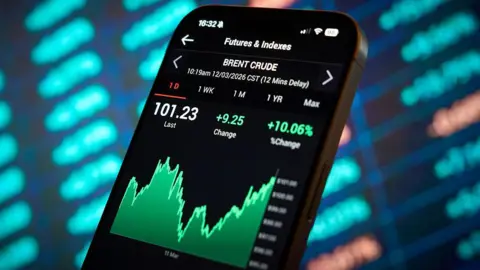
Oil was valued at around $72 a barrel (bbl) before 28 February, when the military action against Iran started.
Recently, it reached a high of $118 a barrel on 19 March and by Friday afternoon was trading at around $112 – significantly up from its pre-conflict price.
Here are several examples from the past month where Trump and the markets appear to have reacted to each other – with varying impacts.
Use the arrow to move to the following chart.
"Oil prices have acted as a barometer for broader political and financial uncertainties, spiking when Trump's rhetoric grows confrontational and declining when his rhetoric softens," says one financial expert.
He states that markets are appropriately sensitive to those messages, due to the significant financial dangers that come with rising oil prices.
"Market participants are trying to assess genuine volatility," he says. "Markets can look skittish or uncertain, but what they're really attempting is managing geopolitical risk in live, with oil positioned directly at the centre of that."
But, it can be tough for investors to figure out how to trade, especially since some of Trump's remarks seem designed to affecting oil prices, as opposed to articulating official strategy, argues another financial strategist.
"As they say, the initial victim of war is truth," he remarks. "My belief is some of the dialogue back-and-forth around diplomatic progress, and the contrary, very much are centred around just shifting the price of oil."
Market Reactions Grow More Muted
On Thursday, minutes after US equity markets experienced their sharpest fall since the beginning of the conflict with Iran, Trump stated discussions with Iran were going "extremely well" and he was postponing military strikes on Iran's oil facilities until at least 6 April.
Yet, the oil price proceeded to rise.
One market analyst points out that market reactions are "showing less volatility" because of the "wide divergence" between Trump's reassurances and the lack of acknowledgement from Tehran.
"Given the optics, many investors can not see an quick conclusion to the conflict and markets remain apprehensive."
Another market expert comments investors have also grown used to Trump "repeatedly changing tack at hints of political, equity market or financial stress".
"There is a level of doubt, or even outright cynicism, creeping in at the fringes," he concludes.


